

Judgment-Centered Design
A framework for making student thinking visible in the age of AI
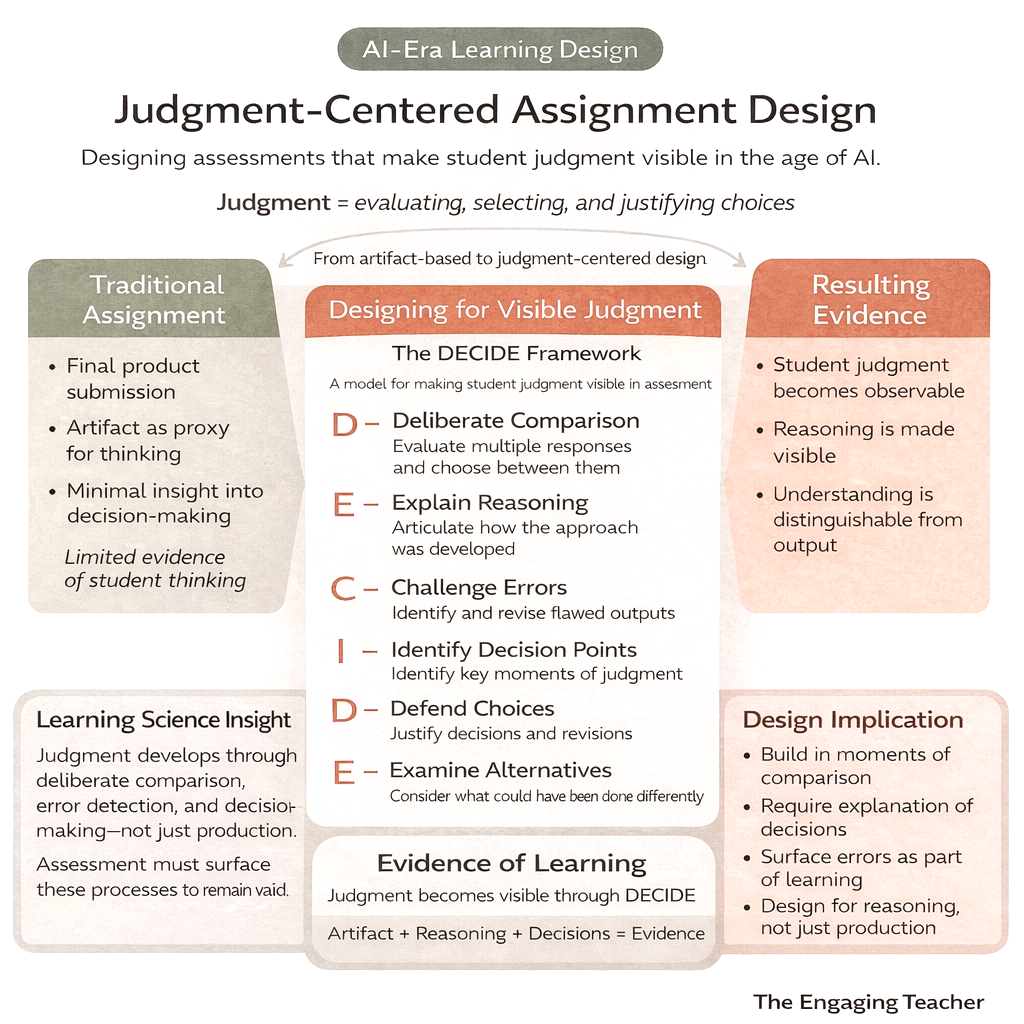
This framework adapts the DECIDE decision-making model (Mintzberg et al., 1976; later variations across disciplines) for use in instructional design and assessment.
When answers become easy to generate, the meaning of an assignment changes.
For a long time, we have treated student work as a window into student thinking. If the artifact was strong, we assumed the reasoning behind it was there. That assumption worked well enough when producing the work required doing the thinking.
But that relationship is no longer stable.
Now, a polished response can be produced quickly, sometimes instantly. And when that happens, the artifact starts to behave less like a window and more like a mirror. It reflects something back, but it does not necessarily show us how it was made.
That shift is subtle, but it matters.
Because the question is no longer what students can produce.
It is what their work allows us to see.
Most assignments were designed for a different set of conditions.
They assume that effort, thinking, and production are tightly linked. If a student submits a strong piece of work, we infer that strong thinking took place.
And for a long time, that inference was reasonable.
Artifacts carried traces of the thinking that produced them. You could see it in the structure of an argument, in the way ideas were developed, even in the mistakes.
But when artifacts can be generated with minimal visible effort from the learner, those traces become harder to trust.
The work might still be strong.
It just does not necessarily belong to the same process.
This is why conversations about AI in education often stall out around integrity. We ask whether the work is authentic, whether the student “really did it.”
But underneath that question is a deeper one:
Are we still designing assessments that make thinking visible at all?
The solution is not to abandon assignments or remove artifacts.
Artifacts still matter. They help students organize ideas, communicate clearly, and produce something shareable.
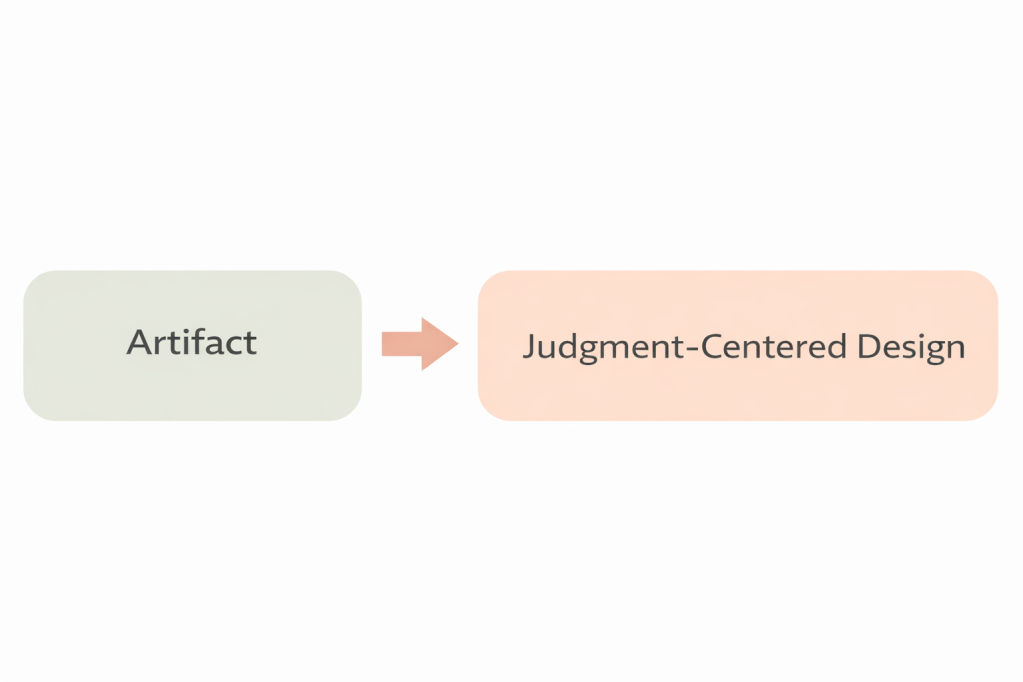
But they are no longer enough on their own.
What needs to change is what we treat as evidence.
Instead of relying on the artifact to carry the full weight of proof, we design assignments that surface the thinking around it.
This is the shift from artifact-based design to judgment-centered design.
It is a shift in what we look for, what we ask students to do, and what we count as learning.
Judgment is not a vague or abstract idea. It shows up in very specific moments.
It is the moment a student decides which argument is stronger. The moment they revise a sentence because it no longer says what they meant. The moment they recognize that one approach works better than another and choose to follow it.
In other words, judgment is where thinking becomes directional.
Students are not just generating possibilities. They are selecting among them. Not just producing an answer, but deciding what counts as a good one.
That kind of thinking leaves a different kind of trace.
It does not always show up cleanly in a final product, but it becomes visible when we ask students to explain, compare, revise, and defend their choices.
And importantly, it is much harder to outsource.
Designing for the Moments That Matter
The DECIDE Framework is a way of building those moments into assignment design.
It does not replace what you are already asking students to do. It changes what the assignment reveals by requiring students to engage in evaluation, selection, and justification as part of the work.
Deliberate Comparison
Students evaluate multiple responses and choose between them. This might include comparing their own work to an AI-generated response or weighing different possible approaches before committing to one.
Explain Reasoning
Students articulate how they approached the task and why. The goal is not to restate the answer, but to make the path to that answer visible.
Challenge Errors
Students identify and revise flawed outputs. Error becomes something to work with, not something to hide.
Identify Decision Points
Students surface key moments where judgment was required. These are the points where different choices could have led to different outcomes.
Defend Choices
Students justify what they kept, rejected, or revised. This shifts the focus from finishing the task to evaluating it.
Examine Alternatives
Students consider what could have been done differently and why. This keeps thinking open and comparative rather than fixed.
At a glance, a judgment-centered assignment may not look dramatically different.
Students might still write a paper, complete a project, or respond to a prompt.
What changes is what surrounds the artifact.
Instead of submitting only the final product, students are also asked to compare versions, explain their reasoning, identify where they revised, and justify the decisions they made along the way.
This does not lower expectations.
If anything, it raises them.
Because now students are responsible not only for producing work, but for demonstrating how they evaluated and refined it.
And that is where learning becomes visible.
What We Can See, What We Can’t, and Why That Matters
For years, artifacts have served as a proxy for thinking. They gave us enough information to make reasonable judgments about student understanding.
But proxies only work when the conditions that support them hold.
When those conditions change, the proxy becomes less reliable.
Judgment-centered design responds to that shift by focusing on what cannot be easily replicated: evaluation, selection, and justification.
It allows us to distinguish between a student who can produce an answer, a student who understands the material, and a student who can evaluate and refine ideas.
Those are different levels of learning.
And they deserve different kinds of evidence.
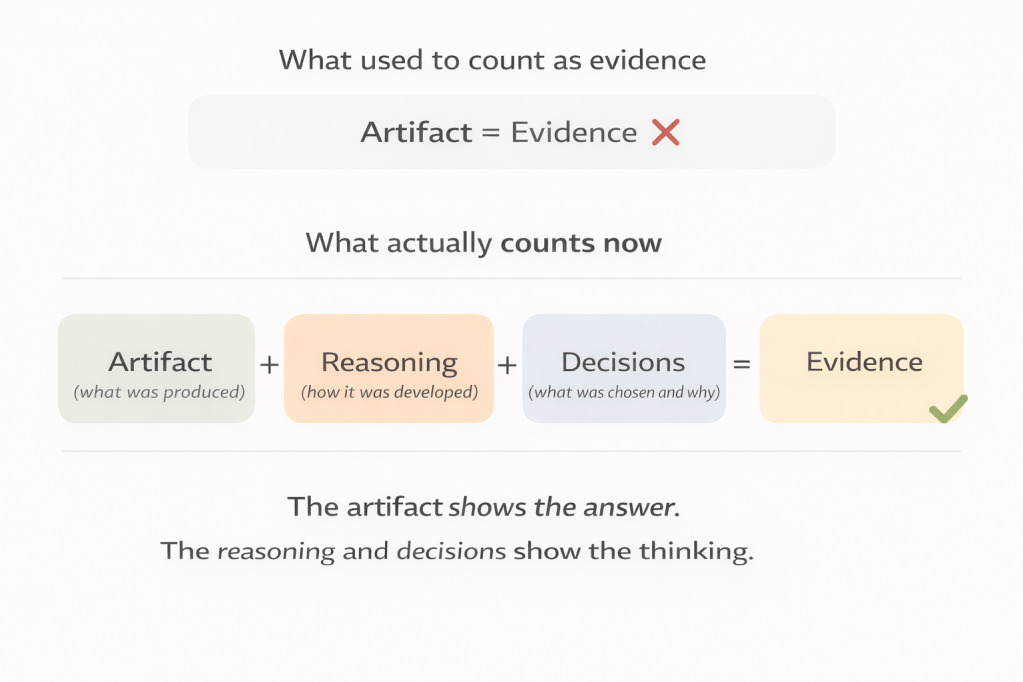
When judgment is visible, evidence of learning becomes more complete.
It is no longer just the artifact.
It is the artifact, the reasoning behind it, and the decisions that shaped it.
Artifact + Reasoning + Decisions = Evidence
The artifact still matters. It just no longer has to do all the work on its own.
How to Start Without Redesigning Everything
This framework is not tied to a specific subject or level. It can be used anywhere students are asked to think, decide, and explain.
In practice, it starts small.
Add a comparison step. Ask students to explain a decision. Build in a moment where they must justify a revision.
You do not need a new assignment.
You need better visibility into thinking.
Those small shifts change what becomes visible. Over time, they change what students learn to notice, evaluate, and refine in their own work.
Start Here
If you want to try this with something you already teach:
→ Download The DECIDE Framework Assignment Design Tool
See It in Practice
Not sure what this looks like in a real assignment?
Here’s a complete example showing how a traditional essay was redesigned to make student thinking visible:
→ Download The DECIDE Framework Worked Example
When answers are easy to generate,
judgment is no longer optional.
It is the work.
The Engaging Teacher
Engaging. Practical. Teacher Built.

 The Engaging Teacher | Instructional Design & Teacher Resources for Classroom Engagement
Leave a comment