
Introduction
Engagement is one of the most overused and underdefined words in education.
It gets mistaken for noise. For participation. For novelty. For compliance wrapped in energy.
But engagement is not about keeping students busy.
It is about creating conditions where thinking feels alive.
In an AI world—where answers are instant and polish is cheap—engagement cannot rely on production alone. If anything, the presence of AI raises the bar. When content is easy to generate, what matters is whether students are actually thinking, choosing, and growing.
Real engagement is not accidental. It is designed.
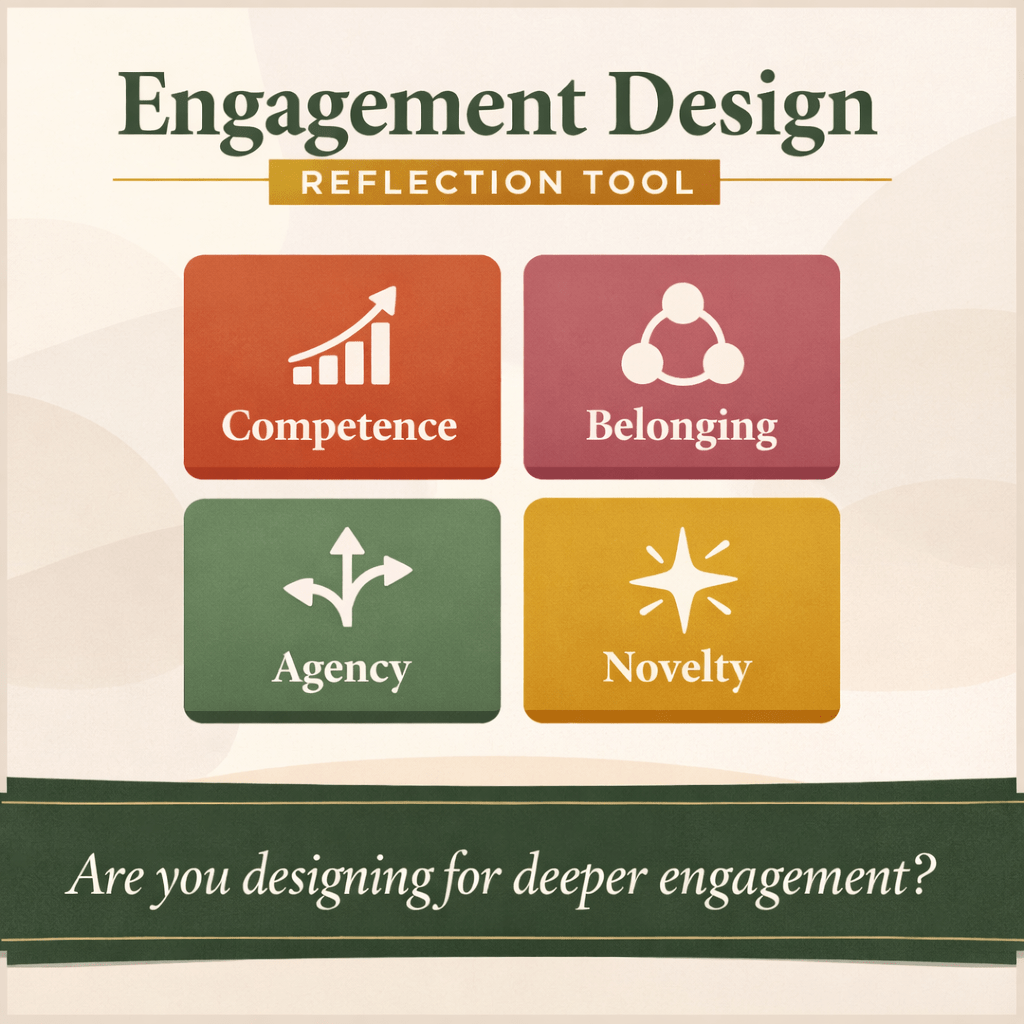
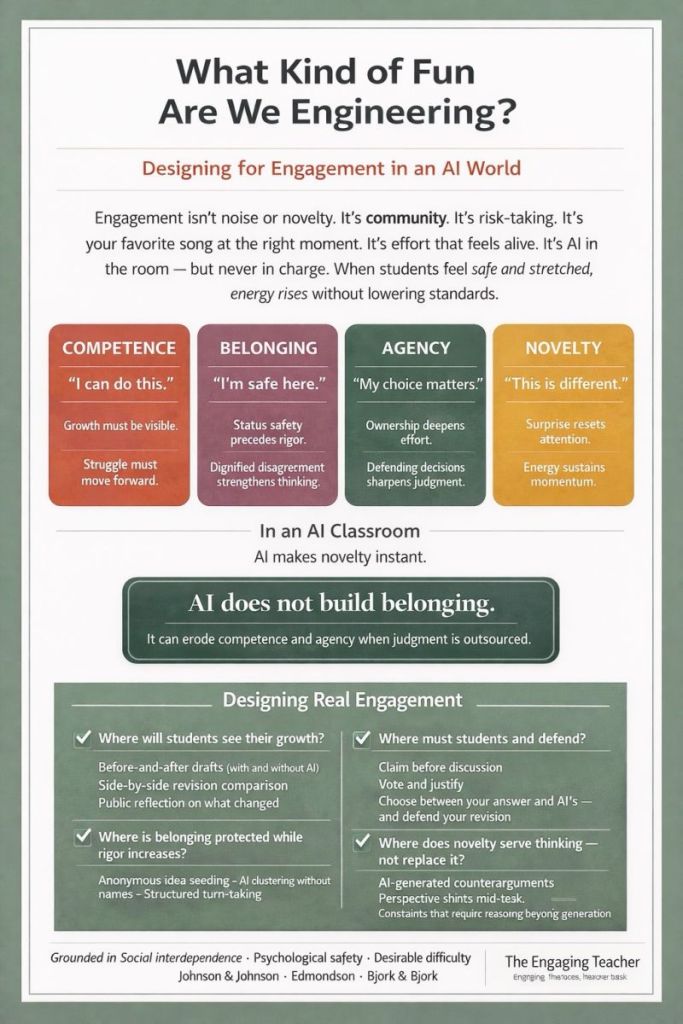
And it consistently emerges when four conditions are present:
- Competence
- Belonging
- Agency
- Novelty
These are not trends. They are structural.
The Model
1. Competence
“I can do this.”
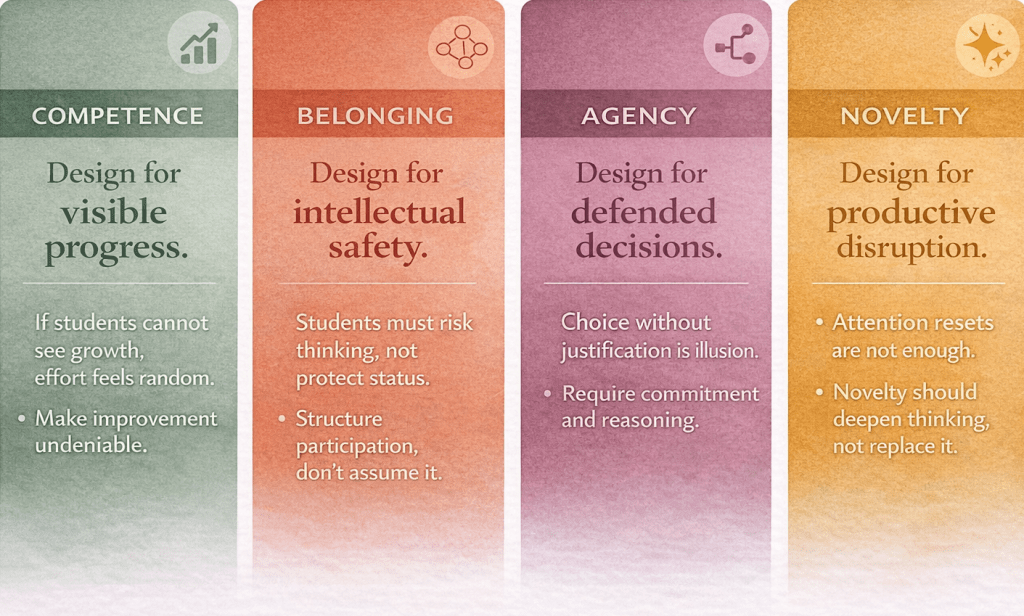
Engagement begins when students believe success is possible—and can see themselves moving toward it.
This does not mean tasks are easy. In fact, the opposite is true.
Challenge is essential. But challenge must be visible and navigable.
When students cannot track their own progress, effort feels random.
When growth is invisible, motivation collapses.
Competence requires:
- Clear criteria for success
- Opportunities to revise and improve
- Evidence of growth over time
In an AI classroom, this becomes even more critical.
If a student can generate a polished answer instantly, the question is no longer “Can they produce?”
It becomes:
Can they improve? Can they evaluate? Can they make something better?
Design for competence by making growth visible:
- Before-and-after drafts (with and without AI)
- Side-by-side comparisons of revisions
- Reflection on what changed and why
Struggle should not disappear.
It should move forward.
2. Belonging
“I’m safe here.”
Students do not take intellectual risks in environments where they feel exposed.
Belonging is not about comfort. It is about psychological safety—the sense that one can contribute, be wrong, revise, and still remain valued within the group.
Without belonging:
- Students perform instead of think
- Silence replaces uncertainty
- Only the most confident voices dominate
And in AI-supported environments, this risk increases.
When answers can be polished instantly, comparison intensifies. Students begin to measure themselves against perfection—real or generated.
Belonging must be intentionally protected.
Design for belonging by structuring interaction:
- Anonymous idea generation before discussion
- Structured turn-taking protocols
- Norms that treat revision as strength, not failure
- Space for dignified disagreement
Belonging is not a feeling you hope for.
It is a condition you build.
3. Agency
“My choice matters.”
Engagement deepens when students are not just completing tasks—but making decisions.
Agency is not simply offering choice.
It is requiring students to commit, justify, and defend their thinking.
In a world where AI can generate options endlessly, agency becomes more—not less—important.
Students must decide:
- Which idea is strongest
- Which revision improves meaning
- Which argument holds under pressure
And then they must explain why.
Design for agency by embedding decision points:
- Require a claim before discussion
- Ask students to choose between their answer and an AI-generated one
- Require justification before revision
- Build in moments where students must defend their reasoning publicly or in writing
Ownership deepens effort.
Defense sharpens judgment.
4. Novelty
“This is different.”
Novelty captures attention—but only temporarily.
In traditional classrooms, novelty is often treated as engagement itself. A new tool, a flashy activity, a surprising hook.
But in an AI classroom, novelty is everywhere.
Anything can be generated instantly. Surprise is no longer scarce.
Which means novelty must be repositioned.
Its role is not to entertain.
Its role is to reset attention and sustain momentum.
Design for novelty that serves thinking:
- Introduce AI-generated counterarguments
- Shift perspectives mid-task
- Add constraints that force deeper reasoning
- Disrupt patterns just enough to require rethinking
Novelty should not replace effort.
It should reignite it.
The Tension: AI and Engagement

AI changes the landscape—but not the fundamentals.
It accelerates production.
It increases access.
It amplifies both strengths and weaknesses in classroom design.
But it does not create:
- Belonging
- Ownership
- Courage
- Intellectual risk
In fact, when poorly integrated, AI can erode the very conditions that make engagement possible.
If students outsource judgment:
- Competence weakens
- Agency disappears
- Belonging becomes performative
This is why engagement must be engineered—not assumed.
Designing for Real Engagement
COMPETENCE
“Wait—I actually got better.”
I can see what changed.
I know what to do next.
BELONGING
“I don’t feel stupid saying this.”
I can try, revise, and stay in the room.
People respond to my ideas, not judge me.
AGENCY
“This is my call.”
I have to choose—and explain why.
I can’t just go with what sounds right.
NOVELTY
“Oh—I didn’t expect that.”
Something disrupted my autopilot.
Now I have to rethink.
To design for real engagement, ask:
Where will students see their growth?
- Are there visible revisions?
- Do students compare versions of their work?
- Is improvement part of the task, not an afterthought?
Where must students choose and defend?
- Do students commit to ideas before discussion?
- Are they asked to justify decisions?
- Do they evaluate AI outputs rather than accept them?
Where is belonging protected while rigor increases?
- Are there structures that ensure all voices can enter?
- Is disagreement normalized and productive?
- Is risk-taking safe but expected?
Where does novelty serve thinking—not replace it?
- Are surprises tied to reasoning?
- Do shifts in perspective deepen understanding?
- Are constraints used to push thinking further?
Closing
Engagement is not about making learning easier.
It is about making thinking visible, meaningful, and shared.
In an AI world, where answers are abundant, what becomes rare is:
- judgment
- ownership
- courage
- community
Those do not emerge from tools.
They emerge from design.
The question is no longer:
How do we keep students engaged?
It is:
What kind of engagement are we engineering—and what does it ask students to become?
Try This in Your Classroom
Use: As a planning lens for your next assignment
Download: Engagement Design Reflection Tool
 The Engaging Teacher | Instructional Design & Teacher Resources for Classroom Engagement
Leave a comment