
For a long time, we have operated under a quiet but powerful assumption: that the work someone produces is, more or less, a reflection of what they understand. Not perfectly, of course, but reliably enough that we could build entire systems around it. A well-constructed essay suggested clarity of thought. A strong presentation implied sound reasoning. A polished strategy signaled not only knowledge, but the ability to make decisions within a given context. The artifact stood in for the thinking, and most of the time, that substitution felt justified.
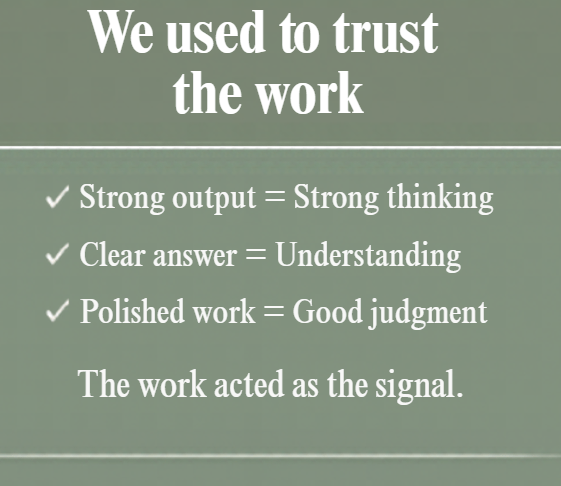
But there is something slightly unstable about that assumption, something that begins to surface the moment you look more closely at how decisions are actually made. Because while the finished work often appears clean, coherent, and intentional, the process that produced it rarely is. Real thinking does not unfold in tidy, linear steps; it moves through hesitation, contradiction, revision, and often a kind of quiet uncertainty that never makes it into the final version. By the time we encounter the artifact, much of that has already been compressed, smoothed over, or forgotten entirely.
Which raises a more unsettling question than we might initially want to ask: when we say we can “see someone’s thinking,” what is it that we are actually seeing?
It is tempting to believe that explanation is enough, that if someone can walk us through their reasoning after the fact, then the reasoning itself must have been present in the moment. But explanation is, by nature, retrospective. It organizes, selects, and clarifies in ways that real-time thinking does not. It tells a story about how a decision was made, but it is not the decision itself, nor does it necessarily reveal what was considered, dismissed, or misunderstood along the way.
Judgment, in contrast, lives elsewhere. It does not reside in the final answer, nor in the polished articulation of a process, but in the series of small, often invisible choices that occur when there is no clear path forward. It is present in what someone notices when faced with competing signals, in what they choose to prioritize under constraint, in how they respond when the initial approach begins to fail. It emerges not when everything is working as expected, but precisely when it is not.
And yet, these are the moments our systems are least equipped to capture.
A report can demonstrate coherence, but it cannot show what was almost included and ultimately left out. A slide deck can communicate clarity, but it cannot reveal which assumptions were questioned and which were accepted without scrutiny. Even the most thoughtful final product offers, at best, a partial view of the thinking that produced it, and often a highly curated one at that.
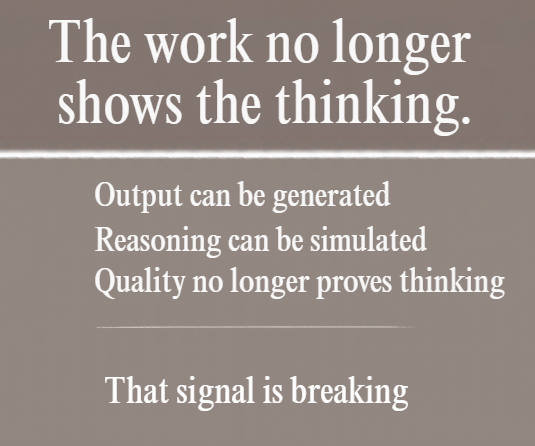
For a long time, this gap between what we could see and what actually mattered was narrow enough to ignore. Producing strong work and exercising sound judgment tended to move together, and so the artifact functioned as a reasonable proxy. But the more we rely on outputs that can be constructed, refined, or assisted in ways that obscure the underlying decisions, the more that proxy begins to break down. The work may still look right, but the connection between appearance and capability becomes less certain.
This is where the language of “making thinking visible” begins to show its limits. Because what we often mean by that phrase is not visibility of thinking in its most consequential form, but visibility of explanation, reflection, or process after the fact. These are valuable, but they are not the same as exposing judgment. They do not necessarily show how someone navigates ambiguity, how they weigh competing options, or how they adapt when conditions shift in ways that render their initial plan insufficient.
To make judgment visible, then, is not simply to ask for more explanation or more detailed accounts of what was done. It is to design for moments where decisions must be made under conditions that are not fully specified, and to treat those moments not as incidental, but as central. It is to create conditions in which the path is not entirely predetermined, where multiple directions are possible, and where what matters is not just the outcome, but how one moves through the space of possibilities.
This shift is subtle, but significant. It redirects our attention from the finished product to the sequence of decisions that produced it, from the surface to the structure beneath. It asks us to consider not only what someone arrived at, but how they responded when what they had was no longer sufficient. It recognizes that capability is not demonstrated in moments of stability, but in moments of adjustment.
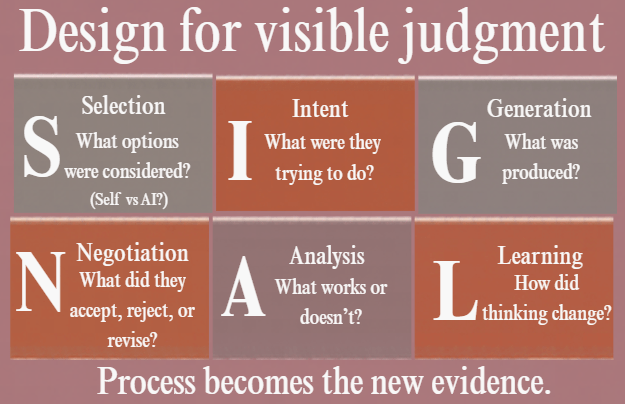
There is, perhaps, something slightly uncomfortable about this, because it requires us to let go of the neatness of artifacts as evidence. It asks us to look at work that may be less polished, less complete, but more revealing of how someone actually thinks when it matters. It challenges the idea that the best representation of understanding is the most refined one, and instead suggests that what we are often missing is not more work, but a different kind of visibility altogether.
And yet, if what we ultimately care about is not simply whether someone can produce something that looks right, but whether they can navigate when it stops being right, then this shift becomes difficult to avoid. Because that is where decisions are made, where consequences emerge, and where the difference between surface-level competence and deeper capability becomes clear.
The question, then, is no longer whether we can see the work, but whether we are seeing the part of it that actually determines what happens next.
An Example of Judgment Process Assessment
Free Resource: SIGNAL Assignment Starter Kit
Download Signal Assignment Starter Kit
Want to try this in your own course?
Use the prompts below to quickly redesign an existing assignment:
- What options will students compare before deciding?
- What decision will they need to justify?
- Where will they explain their reasoning?
- Where will they evaluate strengths or limitations?
- Where will they reflect on how their thinking changed?

 The Engaging Teacher | Instructional Design & Teacher Resources for Classroom Engagement
Leave a comment