
For a long time, we’ve treated student work as a proxy for thinking.
Essay = understanding
Project = mastery
Discussion post = engagement
And for the most part, that worked.
Because producing those artifacts required the thinking itself.
That connection is no longer guaranteed.
AI can now generate structured essays, clean explanations, and polished responses—sometimes faster, sometimes better formatted, and sometimes more “correct-looking” than what a student might produce on their own.
So the problem isn’t just academic integrity.
It’s deeper than that.
We’ve lost reliable signals of learning.
The Shift: From Products to Signals
When a student submits a finished product, we can no longer assume:
- how they got there
- what decisions they made
- what they understood
- or where they struggled
The artifact is still there.
But the thinking behind it is no longer visible.
So the question shifts.
Not:
How do we stop students from using AI?
But:
What actually counts as evidence of learning now?
This is the shift.
Instead of designing assignments around products, we need to design for:
- decisions
- tradeoffs
- justification
- reasoning made visible
In other words:
Not just what students produce, but how they think.
Using the SIGNAL Framework
The SIGNAL framework is not a checklist or a rigid sequence.
It’s a way of asking:
Where, in this task, does thinking actually become visible?
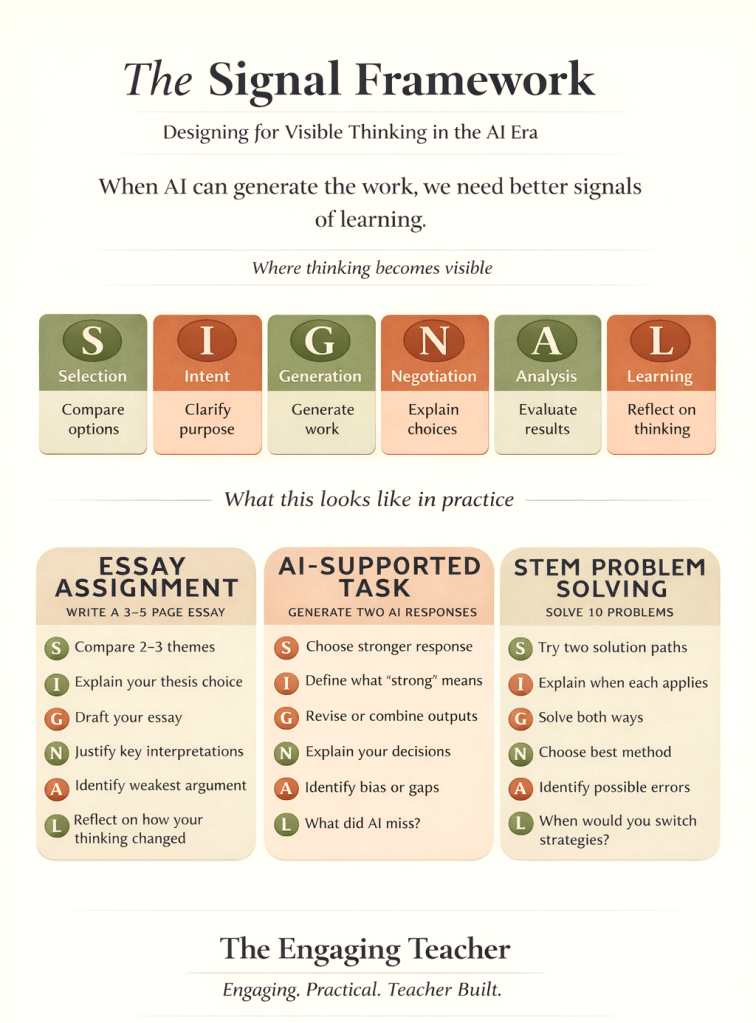
Each element highlights a different place where student reasoning can surface—and where assignment design can make that thinking more explicit.
What follows is not just what each component means, but how it can be used in practice.
S — Selection
Compare options
Selection focuses on the moment before an answer is produced.
In many assignments, students move directly from prompt to response. But thinking often happens in the space where multiple possibilities are considered.
Designing for selection means asking students to surface those possibilities.
This might look like:
- comparing two or more themes, approaches, or interpretations
- outlining multiple solution paths before choosing one
- evaluating different AI-generated responses before selecting
The goal is not to slow students down unnecessarily, but to make visible the range of options they are navigating.
Without this step, we often only see the final choice—not the reasoning that led to it.
I — Intent
Define purpose
Intent clarifies what the student is trying to do.
Students often produce work without explicitly naming their goal. But purpose shapes decisions, and without it, reasoning can be difficult to interpret.
Designing for intent means asking students to articulate:
- what they are trying to argue, solve, or create
- what success looks like for this task
- what criteria they are using to guide their work
This is especially important in AI-supported tasks, where outputs can appear polished regardless of whether they align with a clear objective.
Making intent visible allows instructors to evaluate not just the product, but whether the student’s approach makes sense in context.
G — Generation
Produce work
Generation is the most familiar part of an assignment.
It is the essay, the solution, the response, the project.
In an AI-enabled environment, generation becomes less reliable as a standalone signal of learning. The presence of a well-formed product no longer guarantees the presence of understanding.
This does not mean generation is unimportant.
It means it must be understood as one component within a larger process.
Designing for generation now includes:
- clarifying expectations around AI use
- distinguishing between original and AI-assisted work
- treating the product as something to be examined, not just submitted
The product still matters. But it is no longer sufficient on its own.
N — Negotiation
Explain choices
Negotiation is where students justify their decisions.
Why this idea?
Why this method?
Why this structure instead of another?
This is often the least visible part of student work—and one of the most important.
Designing for negotiation means asking students to:
- explain why they selected one option over others
- justify key claims, steps, or revisions
- describe tradeoffs they considered
In AI-supported contexts, this becomes critical.
Students may generate multiple outputs quickly, but the learning lies in how they evaluate and choose between them.
Negotiation surfaces judgment.
A — Analysis
Evaluate results
Analysis asks students to examine the quality and limitations of their work.
Not just:
Is it done?
But:
How well does it work?
Where does it fall short?
What might be flawed, incomplete, or biased?
Designing for analysis might include:
- identifying the weakest part of an argument
- evaluating the accuracy of a solution
- critiquing an AI-generated response
- comparing outcomes against criteria
This step shifts students from producing answers to interrogating them.
It also creates space for more nuanced understanding, especially when answers are not simply right or wrong.
L — Learning
Reflect on thinking
Learning focuses on how the student’s thinking changed.
This is not reflection for its own sake, but reflection tied to process.
Designing for learning means asking:
- What did you understand differently after completing this task?
- What changed in your approach?
- What would you do differently next time?
This step helps connect individual tasks to broader development.
It also provides insight into growth that may not be visible in a single product.
Putting It Together
Not every assignment needs to include all six elements in equal weight.
In practice, this often starts small.
- Add a comparison step (Selection)
- Ask for a brief justification (Negotiation)
- Include a short reflection (Learning)
Over time, these elements can be layered to create assignments where thinking is more consistently visible.
A Simple Design Check
When reviewing or creating an assignment, ask:
- Where are students making meaningful decisions?
- Where are those decisions visible?
- Where might thinking still be hidden?
The goal is not to make assignments longer.
It is to make thinking easier to see.
The SIGNAL framework does not replace existing forms of assessment.
It reframes them.
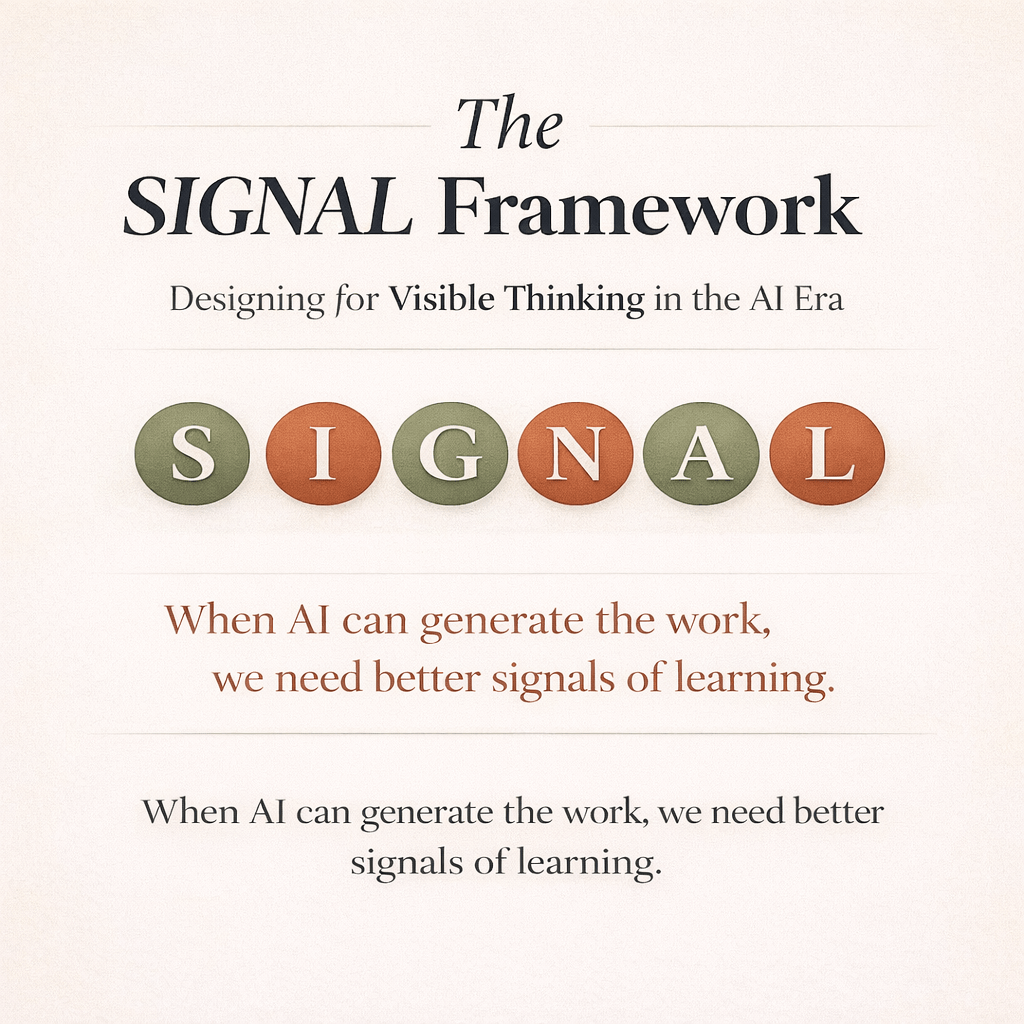
When AI can generate the work,
we need better signals of learning.
Designing for visible thinking is one way to begin.
What This Looks Like in Practice
This shift doesn’t require abandoning existing assignments.
It starts with small changes.
Essay Assignment
Before:
Write a 3–5 page essay analyzing a theme.
After (SIGNAL-aligned):
- Compare 2–3 possible themes before selecting one
- Explain your thesis choice and intended argument
- Draft your essay
- Justify key interpretations and claims
- Identify the weakest part of your argument
- Reflect on how your thinking changed during the process
AI-Supported Task
Task:
Generate two AI responses to the same prompt.
SIGNAL-aligned approach:
- Choose the stronger response
- Define what “strong” means for this task
- Revise or combine outputs
- Explain your decisions
- Identify bias, gaps, or limitations
- Reflect on what AI missed that you had to supply
STEM Problem Solving
Before:
Solve 10 problems and submit answers.
After (SIGNAL-aligned):
- Try two different solution paths
- Explain when each approach is appropriate
- Solve using both methods
- Choose the best method and justify your decision
- Identify where errors are most likely to occur
- Reflect on when you would switch strategies
In each case, the final product still matters.
But it’s no longer the only signal.
A Practical Tool: The DECIDE Framework
The SIGNAL framework operates at the level of design.
It helps answer the question:
Where does thinking become visible in this task?
The DECIDE framework operates within that structure.
It is one way to help students organize and express their thinking inside SIGNAL-aligned assignments.
Together:
- SIGNAL = the design lens
- DECIDE = a practical structure students can use
Free Resource: SIGNAL Assignment Starter Kit
Want to try this in your own course?
Use the prompts below to quickly redesign an existing assignment:
- What options will students compare before deciding?
- What decision will they need to justify?
- Where will they explain their reasoning?
- Where will they evaluate strengths or limitations?
- Where will they reflect on how their thinking changed?
Even adding one or two of these elements can shift an assignment from product-focused to thinking-visible.
This work is still evolving, but the direction feels clear.
When AI can generate the work,
we need better signals of learning.
The question is no longer whether students use AI.
It’s whether we can still see their thinking.
If you want to explore this further, start small.
Add a comparison step.
Ask students to justify a decision.
Build in reflection.
That’s where the signal begins.
Ready to Go Deeper?
If you want to fully redesign an assignment to make student thinking visible, use The DECIDE Framework.
This tool walks through how to:
- examine alternatives
- compare options
- explain reasoning
- identify decision points
- justify choices

 The Engaging Teacher | Instructional Design & Teacher Resources for Classroom Engagement
Leave a reply to Four Conditions of Real Engagement – The Engaging Teacher | Instructional Design & Teacher Resources for Classroom Engagement Cancel reply