Why visibility isn’t enough—and what we can actually trust now
For years, we’ve been told to make thinking visible.
It’s good advice. It’s grounded in learning science. It improves instruction.
But in an AI-mediated world, visibility is no longer enough.
Because now, thinking can be simulated.
Students can generate work that looks like reasoning.
They can produce explanations, arguments, and reflections that appear coherent and complete.
And often, we can’t tell—just by looking at the final product—what actually happened.
That creates a new problem.
Not a design problem.
A detection problem.
The Assessment Shift
We’ve traditionally treated finished work as evidence of learning.
An essay, a project, a discussion post—these were assumed to reflect the thinking behind them.
That assumption no longer holds.
The product is no longer the evidence.
Capability is.
And capability doesn’t live in the final output.
It shows up in something else.
From Evidence to Signals
In stable conditions, artifacts can function as evidence.
But in environments where outputs can be generated, refined, or optimized with external support, artifacts become unstable indicators of thinking.
What we have instead are signals.
Not everything in student work is equally meaningful.
Some elements reflect real judgment. Others can be produced without it.
So the question shifts from:
What did the student produce?
to:
What signals of capability are present—and which of those can we actually trust?
Not All Signals Are Equal
This is the gap that often gets missed.
We can make thinking visible.
We can ask for explanations, reflections, and process.
But visibility alone does not guarantee credibility.
Some visible thinking is:
- reconstructed after the fact
- prompted into existence
- or loosely connected to actual decisions
In other words, it looks like thinking—but doesn’t reliably signal capability.
If we stop here, we risk replacing one proxy (the product) with another (the explanation).
Trustworthy Signals of Capability
To move forward, we need to define which signals actually indicate capability under real conditions.
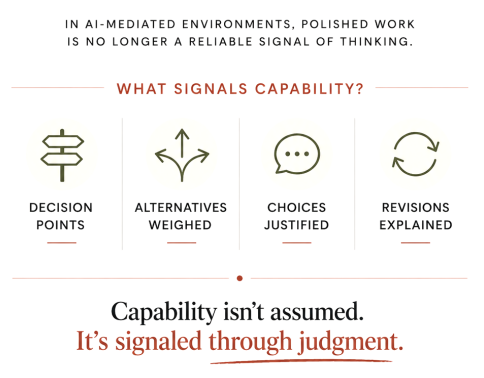
Across contexts, four patterns consistently emerge as trustworthy signals:
1. Decision Points
Moments where a meaningful choice had to be made
These are points of constraint.
Something could have gone multiple ways—and didn’t.
2. Alternatives Weighed
Evidence that multiple paths were considered
Capability shows up in comparison, not just selection.
The presence of rejected options matters.
3. Choices Justified
Reasoning behind decisions
Not just what was chosen, but why—including tradeoffs, priorities, and constraints.
4. Revisions Explained
Changes connected to purpose, feedback, or new understanding
Revision is not just editing.
It is visible adaptation of thinking.
These signals share a common trait:
They are difficult to produce convincingly without engaging in actual judgment.
They anchor our inference in moments where thinking had to occur.
The SIGNAL Lens, Extended
This work builds on the SIGNAL Lens, which focuses on making thinking visible through:
- Selection
- Intent
- Generation
- Negotiation
- Analysis
- Learning
But as the landscape shifts, SIGNAL alone is not sufficient.
We now need a second layer:
A way to evaluate the trustworthiness of what becomes visible.
That is where Trustworthy Signals of Capability operates.
- SIGNAL → makes thinking observable
- Trustworthy Signals → filters for what is credible
Together, they move us from:
- visibility → valid inference
Design, Development, Detection
This also clarifies a broader structure for learning design:
Design for Judgment
Create tasks where students must make meaningful decisions
(DECIDE Framework)
Develop Capability
Support learners until they can make those decisions independently
(Structural Stability Point)
Detect Trustworthy Signals
Identify where capability is actually demonstrated
Without this third layer, we risk designing strong tasks and supporting learning—without being able to confidently interpret the results.
What This Means in Practice
This is not about adding more work.
It is about shifting attention.
Instead of asking:
- Is the product complete?
- Does this look correct?
We begin asking:
- Where are the decision points?
- What alternatives were considered?
- What reasoning shaped this choice?
- What changed, and why?
These questions can show up in:
- assignment design
- feedback conversations
- grading criteria
- student self-reflection
The goal is not to make all thinking visible.
Not all thinking should be visible.
But assessment requires designed access to it.
A New Basis for Trust
In any assessment system, we are making inferences.
We are deciding what counts as credible evidence of capability.
In the past, we relied heavily on the product.
Now, we need to rely on something else.
Capability isn’t assumed.
It’s signaled through judgment.
And judgment becomes visible through specific, interpretable signals.
Where This Goes Next
This is not a finished model.
It is a starting point for a larger shift:
From:
- artifact-based evaluation
To:
- signal-based inference under conditions of uncertainty
That shift matters not just in classrooms, but in:
- hiring
- professional learning
- leadership development
Anywhere outputs can be produced without guaranteed understanding.
A Practical Tool
If you’re looking to apply this immediately, I’ve created a two-page tool that translates these ideas into usable prompts for instruction, feedback, and assessment.
You can download it here:
Final Thought
We don’t just need better assignments.
We need better ways to recognize capability when we see it.
Because in this era, what looks like thinking is no longer enough.
We have to know what to trust.
Leave a Reply