LEARNING & ASSESSMENT
Design learning that reveals how people think.
The finished product matters. But it is only one part of the evidence.
These frameworks help educators, learning leaders, coaches, managers, and AI enablement teams design experiences that support engagement, preserve productive thinking, and make judgment easier to see.
THE CENTRAL QUESTION
What actually counts as evidence of learning?
For a long time, we relied on a simple assumption: if the final work was strong, the thinking behind it must have been strong too.
AI weakened our confidence in that inference, but it did not create the underlying problem. A polished essay, report, presentation, recommendation, or completed task has never been identical to understanding.
Evidence becomes more trustworthy when the thinking behind the work becomes visible.
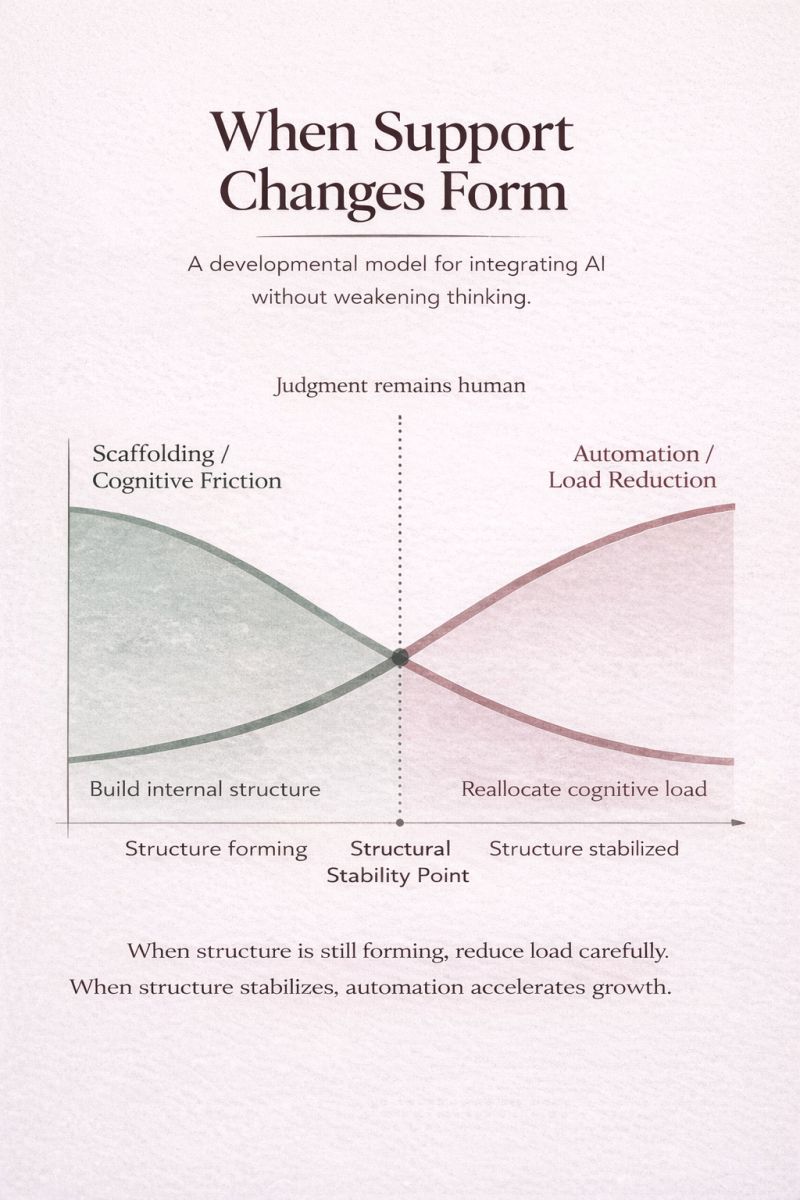
THE STRUCTURAL STABILITY MODEL
Support should change as internal structure develops.
Early in learning, effort is not simply inefficiency. Practice, comparison, retrieval, uncertainty, and productive friction help people build the internal structures they will later use to recognize patterns and make decisions independently.
Once that structure stabilizes, support can change form. Automation can reduce unnecessary cognitive load, accelerate execution, and free attention for interpretation, evaluation, and higher-level judgment.
When thinking is still forming, AI should stretch it.
When thinking stabilizes, AI can accelerate it.
Judgment remains human throughout.
Image: A conceptual developmental model informed by cognitive load theory, desirable difficulties, scaffolding, the expertise-reversal effect, and research on how learners build and apply internal knowledge structures.
KEEP THE PRODUCT. EXPAND THE EVIDENCE.
A strong task makes the intellectual work visible.
The goal is to design moments where people must interpret the context, use evidence, make choices, explain what they emphasized or rejected, create for a real audience, and reflect on how their judgment shaped the result.
A learner can still write the essay, deliver the presentation, build the prototype, recommend a strategy, or complete an authentic performance task. The goal is not to replace meaningful work with endless explanation.
Judgment Forward THINKING PATH
Interpret→
Support →
Decide →
Justify →
Create →
Reflect ↨
This pathway can be applied to classroom assignments, professional learning, interviews, case studies, simulations, coaching, leadership development, and workplace decision-making.
Applied Example (K-12): Learning Task with Judgment Forward Thinking Path

THE VISIBILITY PROBLEM
Evidence of learning depends on evidence of thinking.
The Assessment Visibility Matrix examines two dimensions: how visible the learner’s judgment becomes and how heavily the assessment relies on the final artifact as evidence.
It compares artifact submission, process reflection, recorded reasoning, and AI transparency. The goal is not to eliminate artifacts, but to pair them with evidence of decisions, revisions, evaluation, and intellectual ownership.
FRAMEWORKS & TOOLS
Choose the resource that matches the design problem.
UNDERSTAND HOW JUDGMENT DEVELOPS
The Learning Foundations of AI Judgment
Explore the learning conditions that allow knowledge to become interpretation, judgment, and independent application.
REDESIGN AN EXISTING TASK
The DECIDE Framework
Add comparison, explanation, error analysis, decision points, defended choices, and examination of alternatives to something you already use.
Deliberate Comparison · Explain Reasoning · Challenge Errors · Identify Decision Points · Defend Choices · Examine Alternatives
ADD BETTER QUESTIONS
12 Moves for Visible Judgment
Use prompts that reveal comparison, justification, uncertainty, revision, decision-making, and transfer.
STRENGTHEN THE CONDITIONS
Four Conditions of Real Engagement
Examine whether the environment supports agency, belonging, competence, and curiosity.
ACROSS CONTEXTS
The setting changes. The design questions remain.
Education
Reveal interpretation, evidence use, choices, revision, and transfer alongside the final assignment.
Workplace Learning
Move beyond completion data by examining diagnosis, decision quality, adaptation, and application.
Leadership & Coaching
Surface how people interpret uncertainty, weigh alternatives, revise assumptions, and justify consequential choices.
“Assessment is not about proving what someone knows.
It is about creating opportunities for thinking to become visible.”
THE HUMAN PART
Design learning that reveals the human part.
Subscribe for essays, frameworks, and practical resources about engagement, learning, judgment, assessment, and human capability.