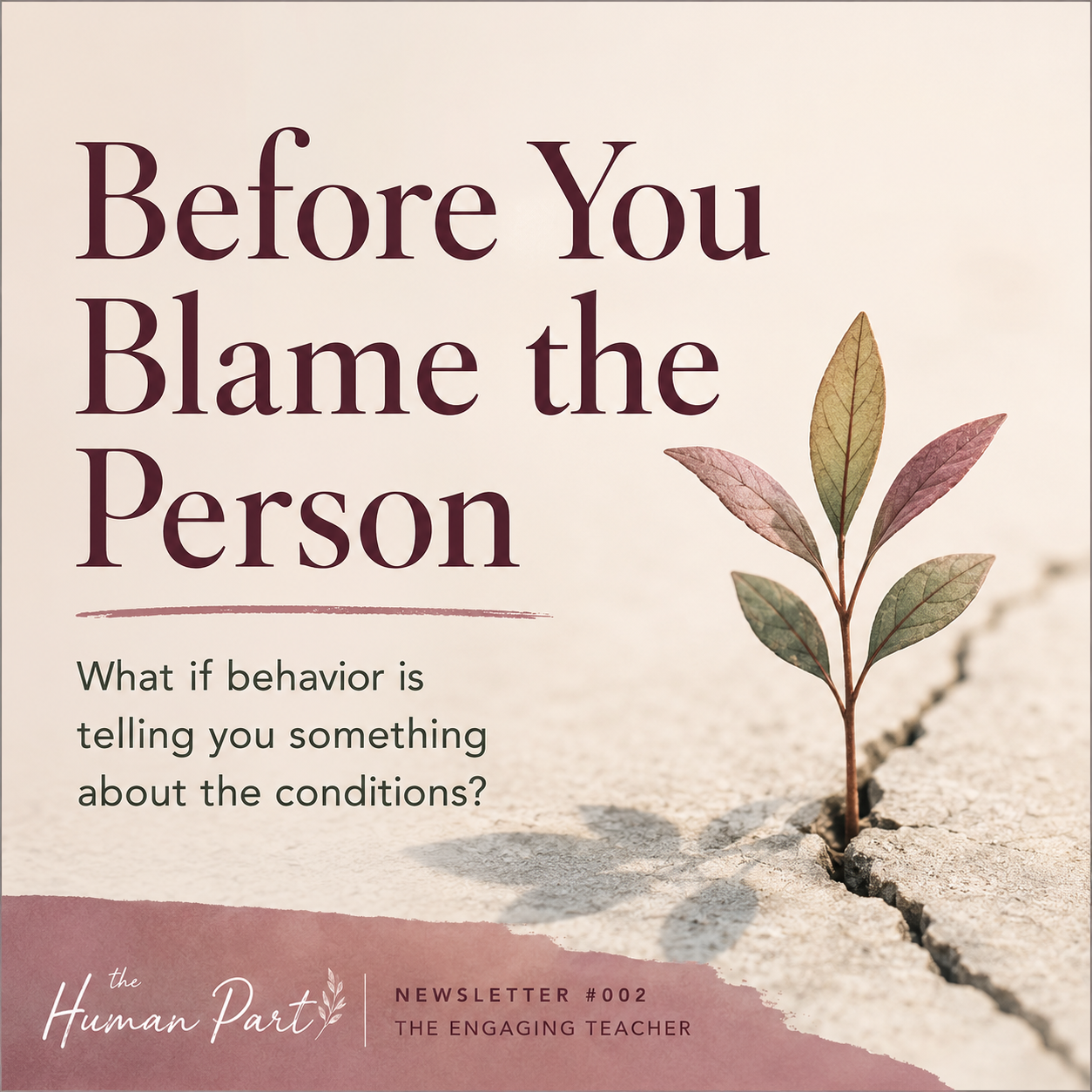
The Stories We Tell About Behavior
One of the stranger things I’ve started noticing lately is how quickly we explain people.
A student doesn’t participate.
An employee seems checked out.
A team resists a new initiative.
A colleague stops contributing ideas.
A child melts down over something that appears, at least to adults, spectacularly minor.
And almost immediately, explanations arrive.
They’re lazy.
They’re resistant.
They’re unmotivated.
They don’t care.
Sometimes those explanations are true.
But I’ve started wondering how often they are simply convenient.
Behavior is visible. Conditions are not.
We Don’t Treat Plants This Way
What’s interesting is that we don’t do this with most other living things.
If a hydrangea is struggling, nobody stands over it and says:
“Honestly? This plant just lacks commitment.”
We ask questions instead.
Too much sun?
Not enough water?
Poor soil?
Root-bound?
Something eating the leaves?
We investigate the conditions.
Humans, meanwhile, can be navigating uncertainty, exclusion, chronic failure, unclear expectations, lack of autonomy, cognitive overload, or environments where belonging feels fragile.
And we go:
“Huh. Must be a motivation problem.”
I’ve become increasingly suspicious of motivation problems.
Not because they don’t exist.
Because they seem to be the explanation we reach for when we stop investigating.
Four Questions I Can’t Stop Asking
The longer I work in education, leadership, and learning design, the more I find myself asking a different set of questions:
- Do people feel safe enough to contribute?
- Do they believe they can succeed?
- Do their choices matter?
- Is there a reason to care?
Those questions appear simple.
They’re not.
Underneath them live four conditions that shape an enormous amount of human behavior:
❤️ Belonging
⛰️ Competence
🧭 Agency
💡 Novelty
Not every behavior can be explained through these conditions.
But many can.
Far more than we often realize.
Sometimes what we call motivation is actually belonging, competence, agency, or novelty in disguise.
The Difference Between a Person Problem and a Condition Problem
Consider a student who never volunteers answers.
One explanation is that the student lacks motivation.
Another is that the student doesn’t feel safe being wrong in public.
Those are very different problems.
One requires changing the person.
The other requires changing the environment.
Or consider a team that seems resistant to change.
Perhaps they are.
Or perhaps they’ve been handed a decision they had no role in shaping.
Resistance and lack of agency often look remarkably similar from a distance.
Or consider an employee who appears disengaged.
Maybe they don’t care.
Or maybe they have failed so many times that they’ve stopped believing success is possible.
Low competence and low motivation can produce surprisingly similar behaviors.
The Challenge of Working With Humans
One of the challenges of working with humans is that behavior is visible.
Conditions are not.
We see the silence.
We do not always see the fear.
We see the withdrawal.
We do not always see the exhaustion.
We see the boredom.
We do not always see the absence of meaning.
The behavior arrives first.
The conditions require curiosity.
The behavior is often the clue. Not the conclusion.
Why This Matters
The solutions we choose depend entirely on the stories we tell.
If I believe a student is lazy, I respond one way.
If I believe they are protecting themselves from embarrassment, I respond differently.
If I believe an employee lacks initiative, I lead one way.
If I believe they feel powerless, I lead another.
Diagnosis shapes intervention.
And bad diagnosis creates bad solutions.
A Different Way to See Disengagement
The irony is that many of the people we call disengaged are often deeply engaged.
Just not with the thing we want.
They’re engaged in self-protection.
They’re engaged in uncertainty.
They’re engaged in avoiding failure.
They’re engaged in navigating systems that do not feel designed for them.
Human beings rarely stop responding to their environments.
We simply respond in ways that are sometimes inconvenient for the people observing us.
People are rarely responding to nothing.
Conditions and Accountability Are Not Opposites
This doesn’t mean people are never responsible for their choices.
They are.
Agency matters.
Accountability matters.
Expectations matter.
But responsibility and conditions are not opposites.
A teacher can hold high expectations while creating belonging.
A leader can expect excellence while building competence.
A coach can challenge someone while increasing agency.
The goal is not lowering standards.
The goal is understanding what makes growth possible.
Better Questions
Lately I’ve become convinced that some of our most important work is learning to ask better questions.
Not:
“What’s wrong with this person?”
But:
“What might this behavior be trying to tell me?”
Not:
“How do I make them care?”
But:
“What conditions make caring more likely?”
Not:
“How do I get engagement?”
But:
“What conditions tend to produce it?”
Final Thought
Because sometimes the behavior is not the story.
Sometimes it is the clue.
And sometimes the most effective thing we can do is stop blaming the person long enough to investigate the conditions.
— Brooke A. McKinney
The Engaging Teacher
Continue Exploring
📖 Read: The Four Conditions of Real Engagement
📥 Download: The Four Conditions of Real Engagement Field Guide
🌿 Subscribe: The Human Part Newsletter
Leave a Reply