One of the most common responses to AI in education sounds something like this:
“Now that students have AI, we need to make learning harder.”
Maybe.
But I think there’s a question we should ask first.
If we expect students to operate at higher levels because AI can support foundational tasks, are we also teaching them the skills necessary to do that well?
Prompting.
Evaluating outputs.
Verifying information.
Recognizing bias.
Identifying hallucinations.
Making informed decisions about when AI should—and should not—be used.
In other words, AI literacy.
Because “just use AI” is quickly becoming a hidden prerequisite in many classrooms and workplaces.
Some learners arrive with those skills.
Many do not.
That creates an equity problem.
But it also creates a learning problem.
Higher-order thinking doesn’t appear simply because a tool exists.
Judgment still requires foundations.
Students still need opportunities to build understanding, wrestle with ideas, receive feedback, and develop expertise.
The goal is not to protect students from AI.
Nor is it to accelerate past the learning process.
The goal is to help learners develop the judgment necessary to use AI well.
That realization led me to another question:
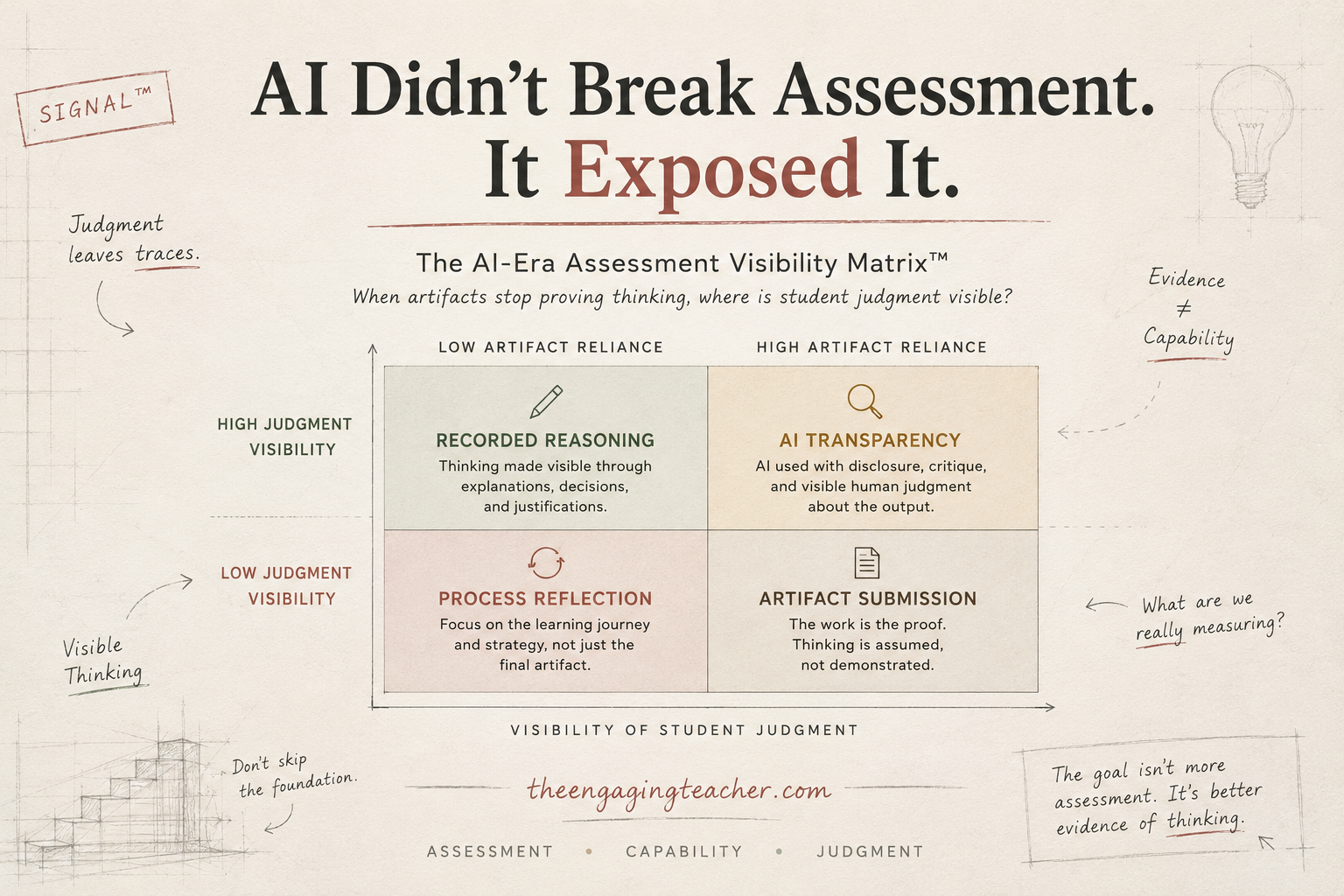
If AI changes how work is produced, how should we think about evidence of learning?
To explore that question, I created the AI-Era Assessment Visibility Matrix™, a simple framework that helps educators identify where student judgment is visible and where learning is being inferred from artifacts alone.
Free Download
The guide includes:
- The AI-Era Assessment Visibility Matrix™
- Practical examples
- Reflection questions
- A visibility audit for educators and leaders
Because the future of learning isn’t simply harder assignments.
It’s helping learners develop the judgment to use powerful tools wisely.
Leave a Reply