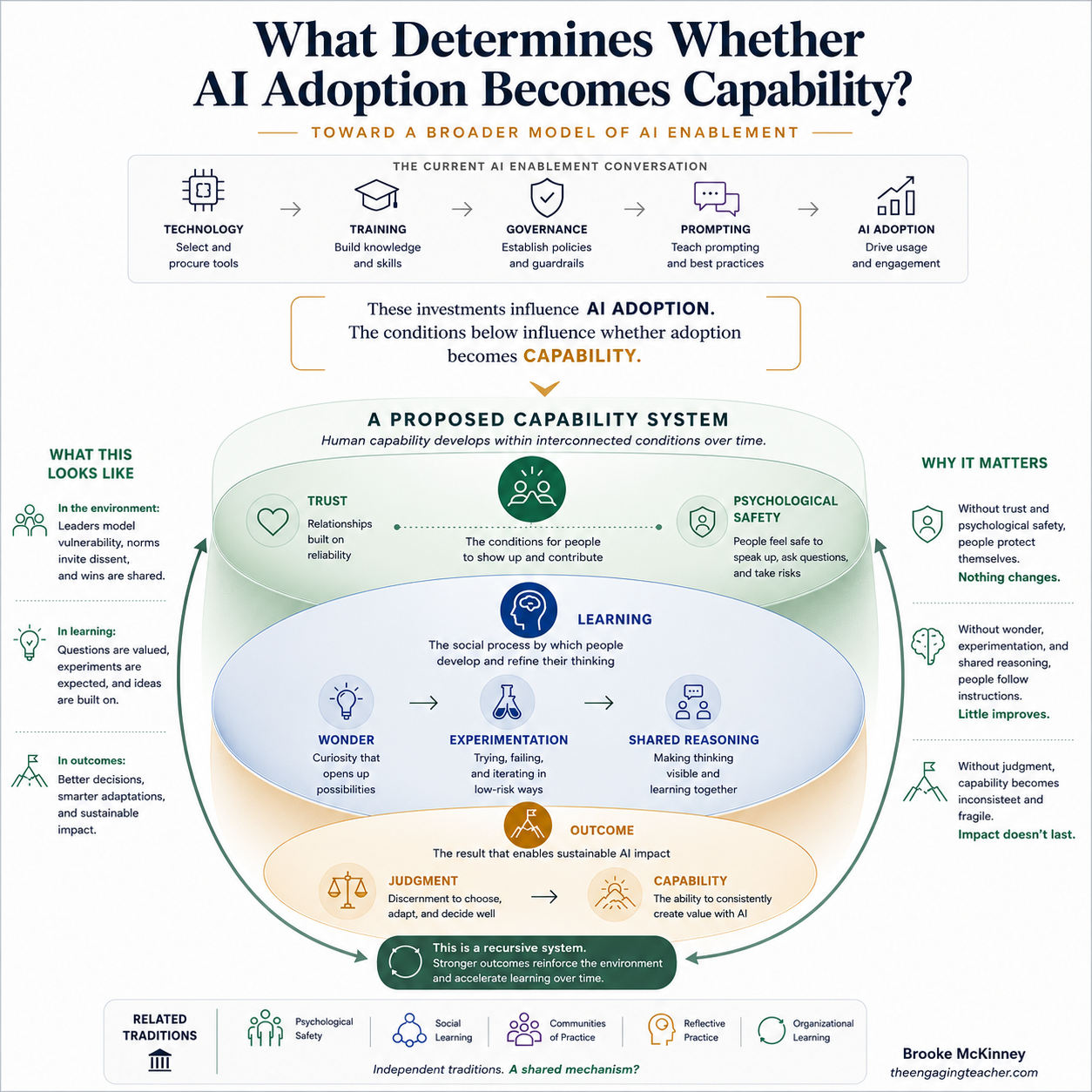
Toward a broader model of AI enablement.

AI adoption has become one of the most measurable initiatives in modern organizations.
Technology budgets can be tracked. Training completion rates can be reported. Governance policies can be audited. Dashboards can show prompt usage, active users, and license utilization with remarkable precision.
Yet one question remains surprisingly difficult to answer.
What determines whether AI adoption actually becomes organizational capability?
It’s a question that matters just as much to a CFO evaluating return on investment as it does to a COO leading organizational change, an AI Enablement Manager designing adoption strategy, or an instructional designer building learning experiences. Because while organizations are becoming increasingly effective at measuring AI adoption, many are still struggling to explain why similar investments produce dramatically different outcomes.
Some organizations see AI become woven into better decisions, faster innovation, and stronger collaboration.
Others see the same technology become little more than another productivity tool.
The difference may not be where most of us have been looking.
The Visible Side of AI Enablement
Most AI enablement strategies share a familiar pattern.
Technology → Training → Governance → Prompting → AI Adoption
These investments are essential. They reduce barriers to entry, establish expectations, and help people begin using new tools responsibly.
But they also share something else.
They’re highly visible.
Organizations know how to budget for them.
Executives know how to measure them.
Consultants know how to implement them.
They answer an important question:
How do we increase AI adoption?
Increasingly, however, I think they’re only addressing the visible half of the system.
The Question Most Organizations Aren’t Asking
After several years designing AI learning experiences across K–12 education, higher education, and organizations, I’ve noticed something that continues to surface regardless of industry.
Two organizations can implement nearly identical AI initiatives.
The same technology.
The same training.
The same governance.
The same prompting guidance.
Yet one organization gradually develops better judgment, stronger collaboration, and more thoughtful decision-making, while the other struggles to move beyond isolated use cases.
That observation raises a different question.
What determines whether AI adoption becomes organizational capability?
I don’t think the answer is found primarily in better prompts or additional training.
I think it’s found in the human system surrounding them.
The Missing Layer
The model I’m exploring proposes that capability develops through three interconnected layers.
Environment
Before people meaningfully learn with AI, they make social judgments.
Can I admit I don’t know?
Can I question an AI-generated answer?
Can I share a failed experiment without looking incompetent?
Can I publicly change my mind?
Those decisions are shaped less by technology than by trust and psychological safety.
Without those conditions, people tend to protect themselves rather than expose their thinking.
AI becomes private instead of collaborative.
Experimentation becomes cautious instead of curious.
Learning slows before it has the chance to compound.
Learning
When trust and psychological safety exist, organizations gain something far more valuable than participation.
They create the conditions for curiosity.
People begin experimenting.
They compare approaches.
They make their reasoning visible.
They borrow from one another’s successes—and failures.
This is the point where AI stops being an individual productivity tool and starts becoming a shared learning process.
The capability being developed isn’t simply technical proficiency.
It’s collective judgment.
Outcome
Over time, repeated cycles of shared reasoning produce something many organizations are actually trying to build.
Not prompt expertise.
Not software fluency.
Judgment.
The ability to determine when AI should be trusted, challenged, combined with human expertise, or set aside entirely.
That judgment becomes capability.
And capability, unlike adoption, compounds.
Organizations that consistently develop good judgment don’t simply become better at using today’s AI tools.
They become better at adapting to tomorrow’s.
Why This Keeps Appearing Across Disciplines
One of the most interesting parts of this work is that none of these ideas are entirely new.
Psychological safety has long explained why people take interpersonal risks.
Social learning has shown that people learn through observing and interacting with others.
Communities of practice describe how expertise develops collectively rather than individually.
Reflective practice explores how professionals improve through examining their own thinking.
Organizational learning examines how institutions adapt over time.
For decades, these conversations largely evolved in parallel because they addressed different problems.
AI may be one of the first organizational challenges that requires us to consider them together.
Technology has changed.
The underlying mechanisms through which people develop capability may not have.
Beyond Adoption Metrics
Organizations have become increasingly sophisticated at measuring activity.
Training completion.
Prompt usage.
License utilization.
Active users.
Those measures remain valuable.
But they primarily tell us whether AI is being used.
They tell us much less about whether organizational capability is developing.
Future AI enablement may require different questions alongside traditional metrics.
Do people openly challenge AI-generated conclusions?
Do teams compare reasoning instead of simply comparing outputs?
Are experiments visible enough that others can learn from them?
Can employees explain why they reached a decision—not only what decision they reached?
Those questions are more difficult to measure.
They may also be more predictive of long-term performance.
AI Enablement as Organizational Design
Organizations often frame AI enablement as a technology initiative.
Increasingly, I wonder whether it is equally an organizational design challenge.
Technology can be purchased.
Training can be delivered.
Governance can be documented.
Adoption can be measured.
Capability develops differently.
It emerges through environments that make thoughtful experimentation possible, normalize visible thinking, and help people develop judgment together over time.
If that’s true, then trust, psychological safety, curiosity, experimentation, shared reasoning, and judgment are not adjacent to AI strategy.
They are part of its infrastructure.
Perhaps the organizations that gain the greatest advantage from AI won’t simply be those that deploy the best models.
Perhaps they’ll be the ones that design the conditions in which human capability compounds alongside them.
If so, AI enablement isn’t simply becoming a new organizational function.
It’s becoming a design discipline.
Leave a Reply